When veterans think about VA disability claims, a common misconception is that a lack of reporting at the time of an incident guarantees denial. This concern is especially common for survivors of Military Sexual Trauma (MST), who may carry the impact in silence for years, sometimes decades.
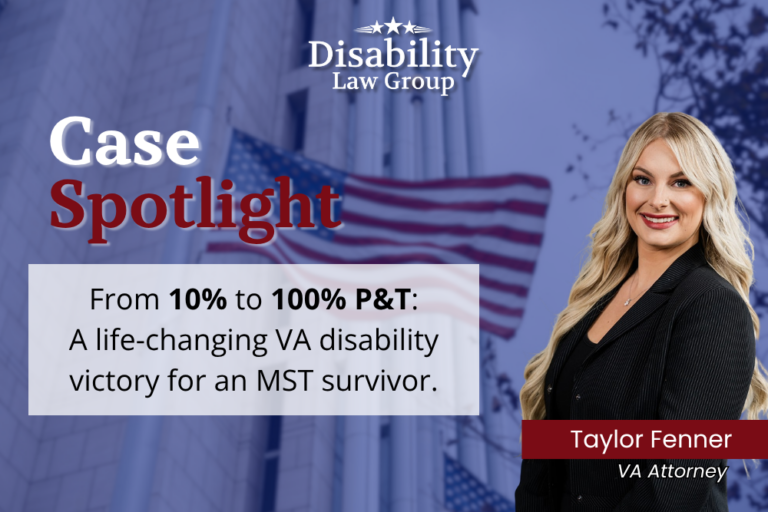
This case spotlight shows how strategic advocacy, a deep review of MST behavioral markers, and persistence through the appeals process helped a Navy veteran increase her VA disability rating from 10% to 100% Permanent and Total (P&T). If you are pursuing an MST VA disability claim, this case shows what can make the difference.
A decades-long fight for recognition and benefits
A 58-year-old Navy veteran from Michigan came to Disability Law Group after being repeatedly let down by the VA disability process. Despite severe PTSD related to MST, along with sleep apnea, migraines, and fibromyalgia, the VA rated her at only 10%.
The VA’s position was blunt: they claimed there was no evidence of an in-service stressor and no medical link, often called a nexus, between her current conditions and her military service. Because her formal treatment began years after discharge, the VA argued her claim lacked proof.
The strategy for an MST VA disability claim without a formal report
Disability Law Group Attorney Taylor Fenner approached the case with a clear understanding of why MST is frequently underreported. As Fenner explained, “Too many survivors suffer quietly for decades. When they are finally ready to share their story, they deserve to be believed and fiercely represented.”
DLG built a multi-layered legal strategy to overcome the VA’s “lack of evidence” argument:
- Identifying MST behavioral markers: The team reviewed service treatment and personnel records for markers such as unexplained injuries, sudden medical visits, behavior changes, or shifts in duty performance. These markers can help support MST-related PTSD claims even when a formal report was never filed.
- Strengthening the record with lay evidence: The claim was supported with detailed lay statements and medical context explaining delayed reporting. This helped demonstrate that silence is often a symptom of trauma, not an absence of it.
- Establishing the nexus and secondary service connection: After securing service connection for PTSD, the team used that foundation to argue that other conditions, including obstructive sleep apnea, were secondary to PTSD and warranted VA disability compensation.
Escalating the appeal to a Higher-Level Review (HLR)
After a partial grant through a supplemental appeal, the fight was not over. The case was escalated to a Higher-Level Review (HLR). This step allowed the team to present focused legal and medical arguments to a senior VA reviewer, highlight errors in the prior decision, and demand a complete review of the marker evidence.
For many veterans, an MST VA disability claim is won at the appeal stage when the evidence is presented clearly.
Result: 100% P&T, Special Monthly Compensation, and $145,000 in back pay
The outcome was fully favorable. The VA acknowledged the veteran’s trauma and the severity of her conditions. The decision included:
- 100% Permanent and Total (P&T) disability rating
- Special Monthly Compensation (SMC-S) due to the combined impact of multiple service-connected disabilities
- Over $145,000 in retroactive VA disability back pay, effective to the original claim date
- Long-term security, including ongoing healthcare access and benefits that may extend to eligible dependents
For this veteran, the financial relief was life-changing. But the recognition mattered just as much: the VA finally acknowledged that what happened to her mattered.
Key takeaway: lack of reporting does not mean you cannot win
This case highlights important truths for veterans pursuing MST-related VA disability benefits:
- A denial is not the end: Many strong cases are won through appeals, supplemental claims, or Higher-Level Reviews.
- MST claims can be proven with markers: When a formal report is not available, the VA can consider behavioral changes and other indirect evidence.
- Your story has weight: With the right legal strategy and evidence, “unprovable” claims can become successful claims.
We’re here to stand with you
MST and PTSD claims are deeply personal and deserve compassion, care, and experienced advocacy. If you or a loved one has been denied benefits, underrated by the VA, or needs help building an MST claim, Disability Law Group is here to help. An attorney can help strengthen an MST VA disability claim by gathering records, identifying markers, and building the nexus.
Contact us today to schedule a free consultation. We are proud to fight for those who have fought for us.